External works are often seen as the final "cosmetic" touch: lay the asphalt, set the kerbs, sow the lawn. In reality this is a full engineering discipline that determines whether lorries can turn around at the warehouse, whether the basement floods in spring and whether the new surfacing will have to be dug up a year later to add a cable. Mistakes here are expensive because they have to be fixed on top of work already completed.
What external works include
- grading design — site falls and levels of roads and hardstandings relative to the building;
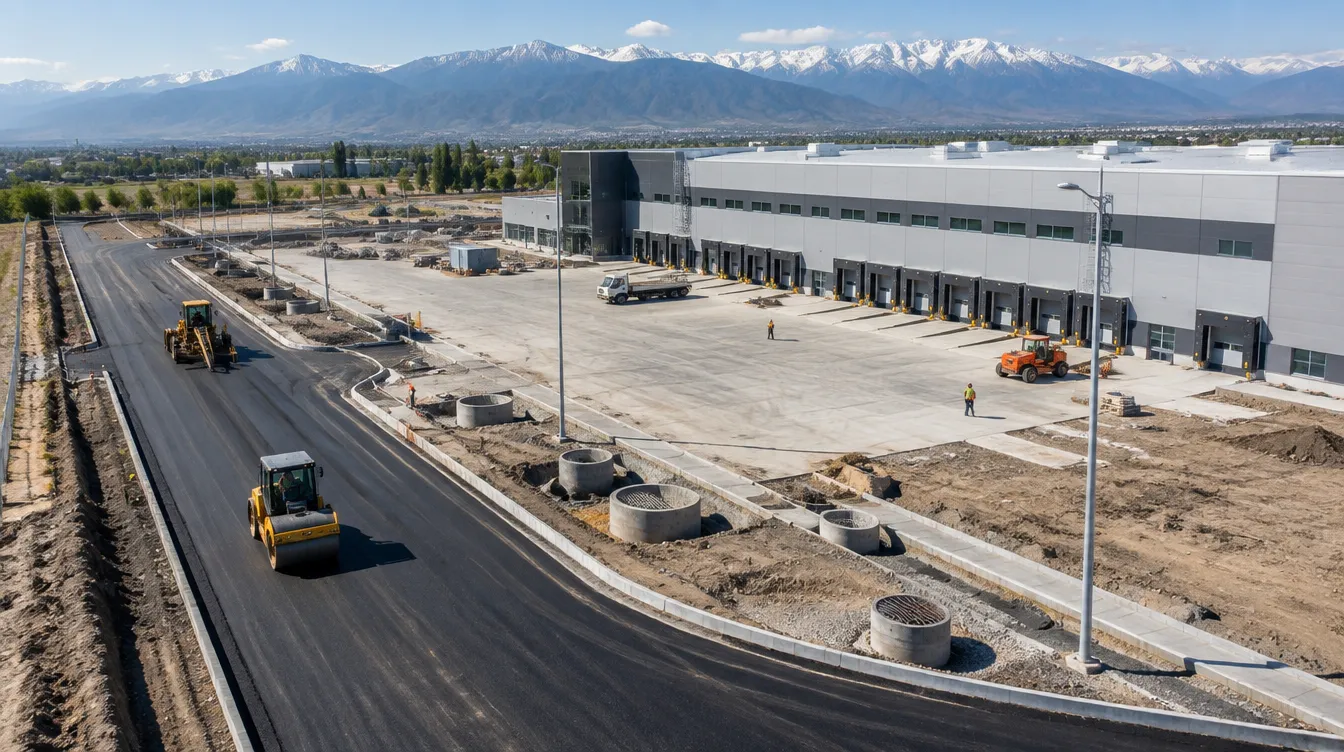
- on-site roads and driveways — for cars, heavy goods vehicles and fire appliances;
- hardstandings — loading and unloading areas, car parks, bin stores, open storage yards;
- external utilities — water mains, sewerage, storm drainage, heating mains, power supply, external lighting and low-voltage networks;
- surface water drainage — channels, gullies, land drainage, perimeter paving;
- footpaths, fencing, gatehouse, planting and street furniture.
Sequence of works: underground first
The golden rule: everything that lies beneath the surfacing is built before the surfacing. The correct sequence looks like this:
- Setting out and topsoil stripping.
- Grading — cut and fill with compaction in layers.
- Laying external utilities in trenches, testing and as-built survey.
- Installing manholes, gullies and ducts for future cables.
- Constructing the sub-base of roads and hardstandings — crushed stone and sand layers compacted with rollers.
- Kerbs, channels and surfacing — asphalt, concrete or block paving.
- Road markings, lighting, planting and fencing.
Lay spare ducts under every road crossing. A pipe costing a few thousand tenge today will save you from digging up a million tenge's worth of asphalt tomorrow.
Roads and hardstandings: what to look out for
Loading. A driveway for cars and a hardstanding for lorries, forklifts and mobile cranes are different structures. The thickness of the sub-base layers and the type of surfacing are determined by a design based on traffic volume and axle loads. Skimping on the sub-base is the most common cause of rutting and potholes after a couple of seasons.
Geometry. Turning radii and road widths must allow the longest vehicles entering the site to turn. For warehouses and logistics centres we model vehicle swept paths at the design stage.
Ground conditions. Kazakhstan has plenty of collapsible and frost-susceptible soils. Unless they are replaced or stabilised, the surfacing will deform after the very first winter.
Concrete or asphalt. Asphalt is cheaper and quicker to lay, and easier to repair. Concrete hardstandings cost more but better withstand point loads from forklift wheels, container feet and trailer legs, as well as fuel and oil spills.
Drainage — the most underrated element
Spring snowmelt and summer downpours test external works more rigorously than any inspection committee. If falls are set "by eye", water collects at the warehouse doors, gets under the foundations and breaks up the surfacing. Surface drainage, gullies and the storm sewer must work as a single system, and stormwater discharge must comply with the conditions issued by the operating utility. Industrial sites may require treatment of runoff — this is determined by the design and agreed with the competent authorities.
External lighting
Lighting levels on roads, hardstandings and the perimeter affect safety and the performance of CCTV. The number of columns and floodlight wattage are designed to standards, and for a preliminary estimate you can use our lighting calculator. Cables to the columns are laid before the surfacing.
Seasonality of works
In most regions of Kazakhstan asphalt works are carried out in the warm season — roughly from April–May to October, with a wider window in the southern regions. Laying on a frozen or wet base sharply reduces the life of the surfacing. So if a building is handed over in winter, it makes sense to complete all underground utilities and the road sub-base in advance, and to move the wearing course and planting to spring — with temporary crushed-stone access roads for the winter. Such a plan should be discussed with the client and built into the programme from the start of the project, so that the deferral does not come as a surprise at acceptance.
Why it pays to use the general contractor
When one contractor builds the building and another does the site, interface problems are inevitable: who is responsible for the perimeter paving, why a manhole ended up half a metre above the asphalt, whose trench has settled. Techno-Module delivers external works in a single cycle with construction: we have our own excavators, bulldozers, motor graders, rollers and tipper trucks — see our fleet in the Equipment section. Our experience in road reconstruction and industrial site development is in the Projects section.
Send us a site plan or layout of your plot and we will propose solutions for roads, hardstandings and utilities, and prepare a cost estimate and works programme that takes the season into account.