Across most of Kazakhstan the construction season officially ends in October, but few can afford to halt a project for five months. This is especially true of Astana, Pavlodar, Kostanay and other northern cities, where frosts last from November to March. Winter concreting makes it possible to continue cast-in-situ work all year round — but only if the technology is followed. Mistakes here are not visible straight away: they show up in spring as cracks, spalling of the concrete cover and strength shortfalls.
Why frost is dangerous for fresh concrete
Concrete gains strength through cement hydration — a chemical reaction with water. Near zero this reaction slows sharply, and when the water freezes it turns into ice, expands by about 9% and destroys the structure of the still immature concrete. If concrete freezes before reaching its so-called critical strength, it will never achieve its design properties after thawing.
The main goal of winter concreting is therefore to keep the structure warm and moist until the concrete is strong enough to withstand freezing. This usually means reaching at least 30–50% of the design strength, and more for critical and prestressed structures; the exact value is set in the design.
Main methods
- The “thermos” method. The concrete mix is placed pre-heated and the structure is insulated immediately. The concrete hardens using its own heat and the heat of hydration. Suitable for massive foundations and moderate frosts.
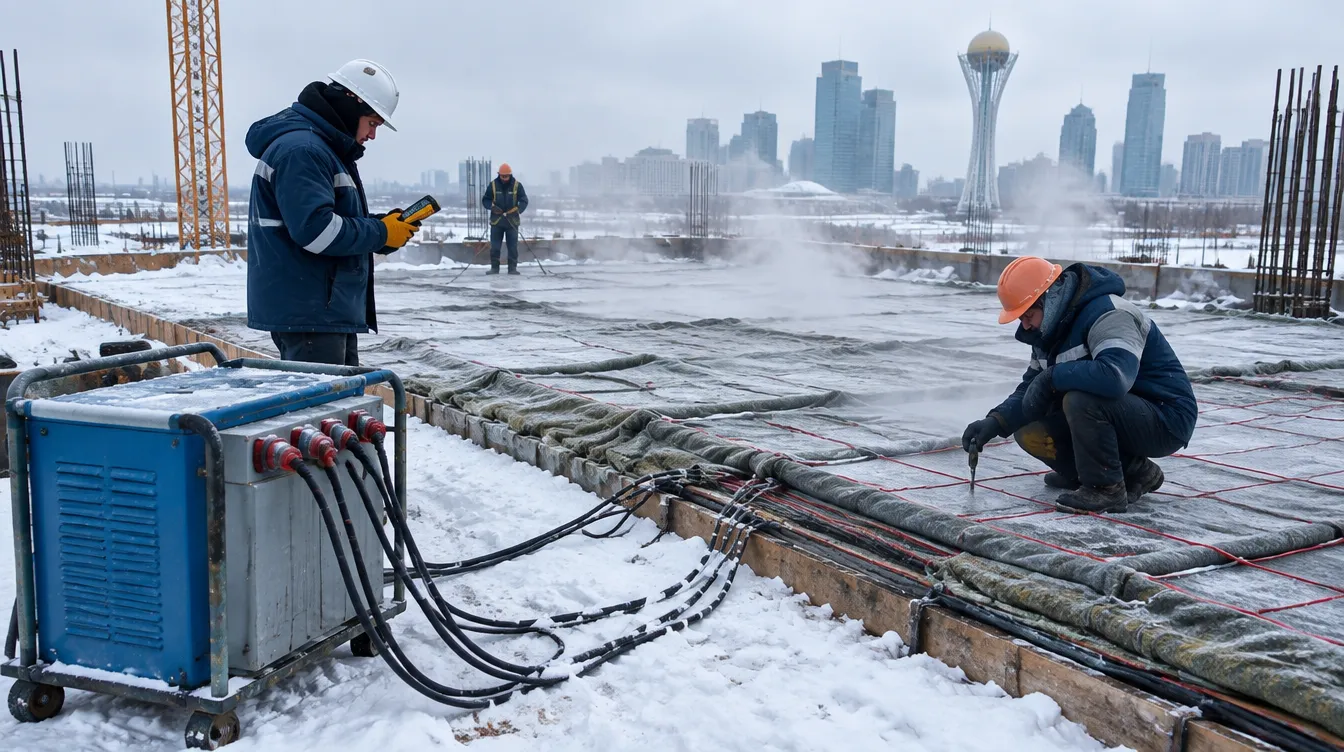
- Electrical heating. Heating cable is embedded in the concrete, or electrodes are used to pass a low-voltage current through it. The most common method for slabs, walls and columns.
- Induction and infrared heating — used for heavily reinforced structures and for warming joints.
- Heated enclosures and space heaters. A tarpaulin shelter is erected over the work area and supplied with warm air. Convenient for small volumes and for warming the base before concreting.
- Anti-freeze admixtures. They lower the freezing point of water and allow concrete to harden in light frost. Most often used in combination with insulation or heating.
Admixtures: a helper, not a magic pill
Anti-freeze admixtures — sodium nitrite, formates, complex blends with plasticisers — are ordered directly from the concrete plant. It is important to remember their limitations: some admixtures must not be used in prestressed and electrically heated structures because of the risk of reinforcement corrosion, and the dosage depends on the expected curing temperature. “Adding salt” to concrete on site is unacceptable — it is a direct route to efflorescence and reinforcement damage.
Preparation and curing
- the base and formwork are cleared of snow and ice, and the ground under the foundation is thawed — concrete must never be placed on a frozen base;
- the mix is delivered in insulated truck mixers, with travel time kept to a minimum;
- concrete is placed continuously, without long breaks, and exposed surfaces are covered immediately;
- the rate of temperature rise during heating and the rate of cooling are limited — a sudden change causes cracking;
- formwork is stripped only after the achieved strength has been confirmed.
Quality control
In winter, control is tighter than in summer. A concrete heating log is kept on site: the outside air temperature and the concrete temperature at control points are measured several times a day, and more often during the first hours of heating. At the same time, test specimens are made, some of which cure under the same conditions as the structure. Strength before stripping and loading is confirmed by testing specimens or by non-destructive methods — rebound hammer, ultrasound, or the pull-off with spalling method.
Winter concrete costs more than summer concrete because of electricity, admixtures and insulation. But that difference is nothing compared with the cost of demolishing a defective structure.
Common mistakes on site
Most winter defects are caused not by the technology but by a lack of discipline. Concrete is transported without drum insulation and discharged already cold. Heating is switched on late or turned off at night “to save money”. Exposed ends and reinforcement starter bars are left uncovered, and the concrete freezes there. Temperatures are entered in the log “from memory”. Formwork is stripped according to the calendar rather than actual strength. Each of these mistakes leads to local strength shortfalls that later have to be strengthened or demolished.
How to budget for winter works
The costs of heating, enclosures and additional control should be in the estimate from the start, rather than appearing “after the fact”. In our calculations they are shown as separate line items, so the client can see what each month of winter construction costs — see “Cost Estimating” for details. You can estimate the overall project cost in the calculator, and see the buildings we have constructed year-round in the “Projects” section.
Techno-Module has been carrying out cast-in-situ concrete works in every season since 1994: our own equipment, heating systems and construction laboratory mean we never have to stop a site in winter. Send us a request and we will calculate the schedule and cost of winter concreting for your project.